Sub-Total: $0.00
Answers Every Rider Needs
Register Horses at ABCR is easy.
Here is a step by step description of how to register horses at ABCR:
- Pay the registration, best by using our Shop items: https://abcregistry.org/#/abcr-shop/4556739651/Registration. You can pay using paypal, check or your credit card.
- Fill in a Pre-Registration application: https://abcregistry.org/#/forms/4560672165. In order to do this, download the Pre-Registration Application as PDF FILE OR fill in the Application ONLINE.
- Wait a little. The ABCR Registrar will send you the UCDavis DNA Registration kit by eMail (registrar@abcregistry.org).
- PULL (DO NOT CUT) 20-30 tail or mane hairs by wrapping hairs around forefinger. For foals, use tail hairs only. The root bulbs are needed!
- Tape the hairs in the form as described therein.
- Fold the form as described therein.
- Put the form with the hair preferably into a cushioned envelope.
IMPORTANT: From outside the US, you need to deliver an Import Permit that comes with the eMail:
- Print Import Permit and Statement of Health letter.
- Read each of the 3 statements on the “Statement of Health” letter.
- If all 3 statements are true, please print your name, telephone number, sign and date the letter. If any one of these statements is not true the Veterinary Genetics Laboratory cannot accept the samples.
- Fold the Import Permit and Statement of Health letter and place them in an envelope.
- Write the words “IMPORT PERMIT” on the outside of the envelope.
- Tape the envelope to the outside of your cushioned envelope with the words “IMPORT PERMIT” facing out.
Once the sample has been verified by UCDavis, the Registrar will issue the pedigree certificate and send it to you together with the DNA results.
Thanks for registering your Horse at ABCR!
For details and questions about the ABCR registrations rules, ask the ABCR Registrar or ask your District Rep.
When sending the DNA form to UC Davis for your Curly friend's ancestral DNA test it is important to pull hair correctly. ABCR Vice President, Angie Gaines, shares a short video of how to do this making sure you pull the hair bulbs which are located on the end of the hair. This is where the DNA is found. We hope you find this video helpful.
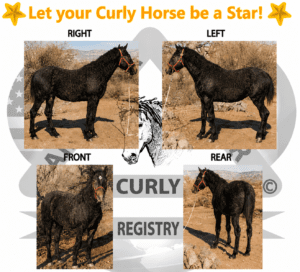
ABCR requires four pictures of your Curly Horse for the registration. One picture will be used for the certificate. These pictures and especially the picture on the certificate shall promote your horse and help to identify it! Learn more about the Do’s and Don’ts when you take your pictures:
- Choose a neutral or scenic background for your pictures. The background should not be cluttered so the focus is on the horse.
- Make sure the ground is even and does not cover hooves or legs. Avoid muddy paddocks or pasture where not all details of the feet can be seen.
- No other horses or people should be seen on the picture.
- Be sure your horse is properly groomed so that all markings can be seen clearly.
- If possible, take your pictures on a sunny day, but be aware of the shadows of yourself and the horse. Best have the sun in the back, considering your own shadow that should not fall across the horse. Best time of the day is early morning or later afternoon.
- The head, front, and hind legs should be seen clearly from all sides. Legs should preferably be spaced apart so that all markings can be seen. The ears should be erect.
- It should be avoided that the horse is grazing while you are taking your pictures since the conformation of your horse might look different then.
- Be sure you get all four feet, legs and the complete head including ears.
- Use a good quality camera, pictures can be sent in by email to abcregistry@aol.com or on a CD or DVD. Be sure that you write down the name of the horse.
Ownership of a registered animal may be transferred as follows:
- SELLER, at time of sale, shall
- OLD CERTIFICATE (no Transfer section on back): forward registration certificate of animal along with Transfer of Ownership/Bill of Sale form to the ABC Registry for transfer by the Registrar.
- NEW CERTIFICATE (Transfer section on back): forward registration certificate of animal, documenting the Transfer at the back of the registration certificate along with Bill of Sale to the ABC Registry for transfer by the Registrar.
- SELLER
- OLD CERTIFICATE (no Transfer section on back): must sign the Transfer of Ownership/Bill of Sale form. Seller’s name must be listed as the legal owner of said animal being sold, as recorded at the ABC Registry or a power of attorney showing authorization to sell the horse for the owner must be filed with the ABC Registry.
- NEW CERTIFICATE (Transfer section on back): and BUYER must sign the Transfer of Ownership at the back of the registration certificate. Seller’s name must be listed as the legal owner of said animal being sold, as recorded at the ABC Registry or a power of attorney showing authorization to sell the horse for the owner must be filed with the ABC Registry.
- Transfer of an ABC registered horse will be duly recorded by the ABC Registrar, who will then forward the certificate directly to the new owner.
- Either the buyer or seller may pay transfer fees.
- OLD CERTIFICATE (no Transfer section on back): Fees must accompany the Transfer of Ownership/Bill of Sale form, and registration certificate before the transfer can be processed and completed.
- NEW CERTIFICATE (Transfer section on back): Fees must accompany the registration certificate/Bill of Sale before the transfer can be processed and completed.
- Each time an ABC registered horse is sold,
- OLD CERTIFICATE (no Transfer section on back): a Transfer of Ownership/Bill of Sale form along with the associated fee must be sent to the ABC Registry.
- NEW CERTIFICATE (Transfer section on back): the registration certificate duly signed by SELLER and BUYER at the back and the Bill of Sale along with the associated fee must be sent to the ABC Registry.
- In the event an ABC registered horse is sold multiple times without the appropriate transfers, the Registrar will proceed with the following procedures:
- New owner requesting transfer of ownership must be a current member
- New owner must submit original ABCR certificate, if any
- New owner must submit Bill of Sale or transfer of ownership from current owner to new owner.
- New owner must submit four current pictures; front, back and both sides of the ABC registered horse being transferred.
- New owner must submit notarized letter stating they have the ABC registered horse in their possession, that they have the original certificate, if any, four pictures to be sent in, and would like the ABC registered horse transferred into their name.
- Two current transfer fees shall be paid:
- One for registered owner as recorded with ABCR to current owner and
- One for current owner to new owner
If there is not an original certificate the new owner must provide the complete name and/or registration number of the ABC registered horse along with the four (4) pictures and current fees for a duplicate certificate to the Registry before a new certificate will be issued. Ownership of a registered animal may be transferred as follows:
- SELLER, at time of sale, shall forward registration certificate of animal, documenting the Transfer at the back of the registration certificate along with Bill of Sale to the ABC Registry for transfer by the Registrar.
- SELLER and BUYER must sign the Transfer of Ownership at the back of the registration certificate. Seller’s name must be listed as the legal owner of said animal being sold, as recorded at the ABC Registry or a power of attorney showing authorization to sell the horse for the owner must be filed with the ABC Registry.
- Transfer of an ABC registered horse will be duly recorded by the ABC Registrar, who will then forward the certificate directly to the new owner.
- Either the buyer or seller may pay transfer fees. Fees must accompany the registration certificate/Bill of Sale before the transfer can be processed and completed.
- Each time an ABC registered horse is sold, the registration certificate duly signed by SELLER and BUYER at the back and the Bill of Sale along with the associated fee must be sent to the ABC Registry.
- In the event an ABC registered horse is sold multiple times without the appropriate transfers, the Registrar will proceed with the following procedures:
- New owner requesting transfer of ownership must be a current member
- New owner must submit original ABCR certificate, if any
- New owner must submit Bill of Sale or transfer of ownership from current owner to new owner.
- New owner must submit four current pictures; front, back and both sides of the ABC registered horse being transferred.
- New owner must submit notarized letter stating they have the ABC registered horse in their possession, that they have the original certificate, if any, four pictures to be sent in, and would like the ABC registered horse transferred into their name.
- Two current transfer fees shall be paid:
- One for registered owner as recorded with ABCR to current owner and
- One for current owner to new owner
If there is not an original certificate the new owner must provide the complete name and/or registration number of the ABC registered horse along with the four (4) pictures and current fees for a duplicate certificate to the Registry before a new certificate will be issued.
Ownership of a registered animal may be transferred as follows:
- SELLER, at time of sale, shall
- OLD CERTIFICATE (no Transfer section on back): forward registration certificate of animal along with Transfer of Ownership/Bill of Sale form to the ABC Registry for transfer by the Registrar.
- NEW CERTIFICATE (Transfer section on back): forward registration certificate of animal, documenting the Transfer at the back of the registration certificate along with Bill of Sale to the ABC Registry for transfer by the Registrar.
- SELLER
- OLD CERTIFICATE (no Transfer section on back): must sign the Transfer of Ownership/Bill of Sale form. Seller’s name must be listed as the legal owner of said animal being sold, as recorded at the ABC Registry or a power of attorney showing authorization to sell the horse for the owner must be filed with the ABC Registry.
- NEW CERTIFICATE (Transfer section on back): and BUYER must sign the Transfer of Ownership at the back of the registration certificate. Seller’s name must be listed as the legal owner of said animal being sold, as recorded at the ABC Registry or a power of attorney showing authorization to sell the horse for the owner must be filed with the ABC Registry.
- Transfer of an ABC registered horse will be duly recorded by the ABC Registrar, who will then forward the certificate directly to the new owner.
- Either the buyer or seller may pay transfer fees.
- OLD CERTIFICATE (no Transfer section on back): Fees must accompany the Transfer of Ownership/Bill of Sale form, and registration certificate before the transfer can be processed and completed.
- NEW CERTIFICATE (Transfer section on back): Fees must accompany the registration certificate/Bill of Sale before the transfer can be processed and completed.
- Each time an ABC registered horse is sold,
- OLD CERTIFICATE (no Transfer section on back): a Transfer of Ownership/Bill of Sale form along with the associated fee must be sent to the ABC Registry.
- NEW CERTIFICATE (Transfer section on back): the registration certificate duly signed by SELLER and BUYER at the back and the Bill of Sale along with the associated fee must be sent to the ABC Registry.
- In the event an ABC registered horse is sold multiple times without the appropriate transfers, the Registrar will proceed with the following procedures:
- New owner requesting transfer of ownership must be a current member
- New owner must submit original ABCR certificate, if any
- New owner must submit Bill of Sale or transfer of ownership from current owner to new owner.
- New owner must submit four current pictures; front, back and both sides of the ABC registered horse being transferred.
- New owner must submit notarized letter stating they have the ABC registered horse in their possession, that they have the original certificate, if any, four pictures to be sent in, and would like the ABC registered horse transferred into their name.
- Two current transfer fees shall be paid:
- One for registered owner as recorded with ABCR to current owner and
- One for current owner to new owner
If there is not an original certificate the new owner must provide the complete name and/or registration number of the ABC registered horse along with the four (4) pictures and current fees for a duplicate certificate to the Registry before a new certificate will be issued. Ownership of a registered animal may be transferred as follows:
- SELLER, at time of sale, shall forward registration certificate of animal, documenting the Transfer at the back of the registration certificate along with Bill of Sale to the ABC Registry for transfer by the Registrar.
- SELLER and BUYER must sign the Transfer of Ownership at the back of the registration certificate. Seller’s name must be listed as the legal owner of said animal being sold, as recorded at the ABC Registry or a power of attorney showing authorization to sell the horse for the owner must be filed with the ABC Registry.
- Transfer of an ABC registered horse will be duly recorded by the ABC Registrar, who will then forward the certificate directly to the new owner.
- Either the buyer or seller may pay transfer fees. Fees must accompany the registration certificate/Bill of Sale before the transfer can be processed and completed.
- Each time an ABC registered horse is sold, the registration certificate duly signed by SELLER and BUYER at the back and the Bill of Sale along with the associated fee must be sent to the ABC Registry.
- In the event an ABC registered horse is sold multiple times without the appropriate transfers, the Registrar will proceed with the following procedures:
- New owner requesting transfer of ownership must be a current member
- New owner must submit original ABCR certificate, if any
- New owner must submit Bill of Sale or transfer of ownership from current owner to new owner.
- New owner must submit four current pictures; front, back and both sides of the ABC registered horse being transferred.
- New owner must submit notarized letter stating they have the ABC registered horse in their possession, that they have the original certificate, if any, four pictures to be sent in, and would like the ABC registered horse transferred into their name.
- Two current transfer fees shall be paid:
- One for registered owner as recorded with ABCR to current owner and
- One for current owner to new owner
If there is not an original certificate the new owner must provide the complete name and/or registration number of the ABC registered horse along with the four (4) pictures and current fees for a duplicate certificate to the Registry before a new certificate will be issued.
Curly Horses come in many coat types, just as human's hair varies, so does a Curly's. Some Curly Horses are even born without any apparent curl to their coats, and these we call Smooth-Coated Curlies. When you see an asterisk in front of the Curly's name it means that they have curls in their coat.
Curly horses come in all colors and vary a lot regarding their size and type. The winter coat expresses itself in a variety of patterns commonly described as Marcel Wave, Crushed Velvet, ...Curl and Micro Curl. The summer coat also offers varieties ranging from smooth to wavy. The manes and tails vary from ringlets, corkscrews to dreadlocks.The hair in their ears and on the fetlocks is wavy or curly, too, and the eyelashed are often considerably curled up.
Around a quarter of all Curly Horses are born with a straight coat, mane and tail. They do not show the characteristics as described above, however, their coat is considerably different to those of other breeds. Especially in winter it is thicker and much softer than the coat of other horse breeds, like bunny hair. Straight Curly Horses seem to have the same hypoallergenic trait like their Curly relatives.
First of all, Curly Horses are horses and act like other horses do. So if you are not very familiar with horses, it is a good idea to have a skilled friend or trainer around to help you. As a beginner, you might want to look for an older, experienced and trained Curly Companion instead of a foal or youngster. However, it is true that Curlies often have a calm temperament and a gentle disposition. Usually they are very curious, people-oriented and often comparably easy to handle, which can make them a real good choice for beginners for sure!
One of the most cherished qualities of the Curly Horse is their calmness and extremely gentle disposition. We do feel that this is one of their finest features. Many have been taken off the open range, even full grown animals, and in a day or two, they are gentler than horses that have been handled for years. Nothing seems to ruffle them. They do not tend to resort too flight when frightened, which has been claimed the horse's greatest means of survival. Most of them soon respond to kindness and affection because of their inherent gentle nature. They will tend to freeze in a tight spot so seldom get themselves hurt, even if caught in dangerous situations. They will delight in human companionship and love to be talked to.
Curly Horses can do anything at all! Curlies are known for being versatile, hardy, gentle horses. In equestrian sports, they are actively used in most of the standard disciplines for other horses such as: competitive and classical dressage, hunter/jumper, eventing, and combined driving. There have been Curly Horses used also in the western disciplines of barrels, reining, gymkhana, and Western pleasure. You will find them being used as trail and pack horses. They compete in endurance and competitive trail. Many are used as 4H & Pony Club mounts or therapeutic horses and are wonderful with these children due to their usually gentle nature. CURLIES CAN DO IT ALL!
ABCR defines a breed as follows: “A breed is a specific group of domestic animals or plants having homo...geneous appearance (phenotype), homogeneous behavior, and/or other characteristics that distinguish it from other organisms of the same species and that were arrived at through selective breeding.” (Wikipedia)
Based on these experiences and recommendations of the old time Curly Horse Breeders, ABCR has developed a breeding standard of the “ideal ABCR Curly Horse” that can be found here.
We encourage our breeders to breed for ALL characteristics that compose the ABCR Curly Hors such as a gentle disposition, a sound and sturdy confirmation, the hypoallergenic trait or the hard hooves.
Research is still going on to find out the genetic settings responsible for these characteristics. ABCR considers DNA typing of the Curly Horses registered with us both as a contribution to this research as well as a proof of parentage which is important for our breeders to make the best breeding decisions possible regarding the horse health and breeding standards.
Hypo-allergenic means that, in this case, the horse is less likely to cause a person who is allergic to horses to have an allergic response. That does not mean that the person will not have an "allergy attack", but that often the symptoms are less severe if they are present at all. So if you visit a Curly Horse, and you are allergic to horses, be sure to take you medicine with you! We do not know exactly why this is so, and studies are on going. We think it may be because the Curly Horse's hair is different than a regular horses, or that the proteins in their skin are different.
The ABCR Breed Standard describes an American Bashkir Curly as being on average 14 to 16 hands and weighing 800 to 1250 lbs. The head is of medium size with a well-defined jaw and throat latch. The eyes are wide set with eyelashes that curl up. Ears are short to medium in length with curls inside. The neck is of medium length and deep at the base where it joins the shoulder. The back is noticeably short and deep through the girth. The legs are heavy boned with short cannon bones as compared to the forearm. They have a curly coat in wintertime and generally display a notable gentle disposition.
Yes, we have! One of our breeders, Barbara Carroll from Stag Creek Farm, TX, was on TV in The Horse Show with Rick Lamb. So sit back, relax, enjoy watching it and learn more about the Curly Horse!
Cushing's disease in horses typically develops as the horse enters its senior years. Equine Cushing’s Disease is a result of a number of hormone related problems that derive from changes in the brain.
Unlike the Curly Horse, Horses with Cushing Syndrome have a hard time shedding their coats in spring. Excessive thirst and urination, increased appetite with no weight gain, loss of muscle over the top line as well as chronic laminitis are symptoms for Cushings, too.
Another difference is that the 'curls' of a horse with the Cushing Syndrom are seen only in body hair, it's ear hairs, fetlocks, mane, and tail are straight.
The curly coat of a Curly Horse is NO SIGN for a disease at all, but a wanted characteristic of the Curly Horse breed! On the picture here, we are definitely looking at a Curly Horse. Their curls in ears, mane, fetlocks and tail do not shed in spring, but are also visible in summertime!
There have been many theories on this, some believing that the "curly" part of the horse came from the Bashkir region of Russia, some feeling perhaps from the Lokai horses of Tajikistan. To this date nothing has been accurately proven. What is known is that the earliest documented Curly Horses in North America were with Native Americans in the Winter Count of 1801-2. At this time it was said that the Sioux had stolen Curly horses from the Crow. From then to now, several ranchers/breeders have been responsible for maintaining Curly Horse breeding. Some of the names you will hear are: Damele, Eli Bad Warrior, Berndt, Neidhard, Skjonsberg, and Fredell. There are also Missouri Foxtrotters who, for an unknown reason, carry a dominant Curly gene. The founding sire of that line is *Curly Jim". Additionally, some curly horses carry a recessive gene for curly coats, two of which are Missouri Foxtrotters and Percherons.
Curly Horses were originally found in Western North America. From there they have spread to the Eastern side of the continent, to Europe, and to Australia. There are less than 4,000 registered Curly Horses alive!
Curlies are horses. When we keep horses in a domestic environment we need to do things for them that wild horses may not require. Curlies, like any other, do best when their vaccinations, farrier work, and de-worming is kept up to date for their home area. Many Curly Horses are not shoed because they tend to have naturally round and hard feet; however, depending on where they live and what they do, you may find them with shoes.
Most Curly Horses do get some grain or other feed supplement, again depending on where they live. Each region brings its own vitamin and mineral requirements that the horse cannot get from their hay ration. It is best to speak with a local veterinarian to find what is best for your area; however, many Curlies are "easy keepers" and do not need as much grain as a different breed of horse. Again, check with your veterinarian!